
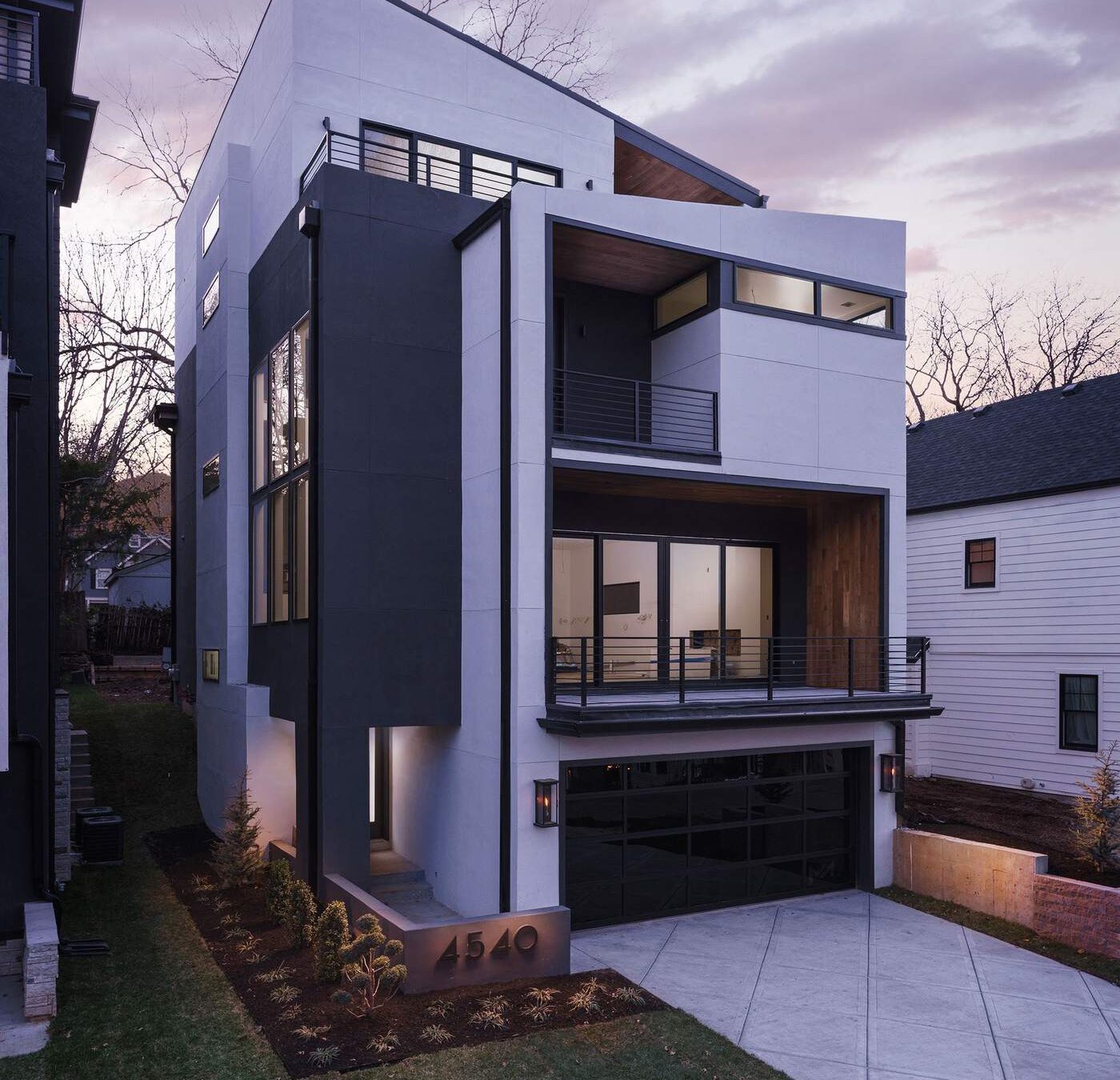
Production homes — built from a repeatable, pre-engineered plan across many lots in a development — almost always cost less upfront than a fully custom home of similar size. That price difference is real, but it’s worth understanding exactly what it buys (and doesn’t buy) before treating it as the whole comparison.
A production builder’s efficiency comes from standardization: the same floor plans, the same material packages, and the same trade crews moving from house to house. That repetition lowers cost, but it also means structural decisions, material specifications, and even small layout details are fixed long before you ever see the lot — there is limited room to shape the home around your specific life.
A custom home flips that tradeoff. You’re paying for a structure, layout, and material palette designed specifically around your site and your priorities, plus the project management required to execute a one-off design rather than a repeatable one. That cost shows up in design fees, more involved engineering, and typically a longer pre-construction timeline.
Long-term value is where the comparison gets more interesting. Custom homes, particularly those built with attention to architectural detail and site-specific design, tend to hold their value and differentiate themselves in resale markets more than a production home built from a widely repeated plan in the same subdivision.
The right choice depends on what you’re actually optimizing for. If speed and predictable cost matter most, a production home is a reasonable, well-understood path. If you have a specific lot, a specific vision, or simply want a home that doesn’t look like six others on the same street, a custom build is the only way to get there.
Compare the total cost, not just the base price
A production builder may advertise a starting price that excludes lot premiums, structural options, upgraded finishes, landscaping, window treatments, and some closing costs. A custom proposal may also exclude land, design fees, engineering, permitting, utility work, or site preparation. Neither format is inherently misleading, but comparing the two without matching scope can produce a false impression of savings. Request a written list of inclusions and exclusions for both options.
Financing structures may differ as well. A completed production home is often purchased through a conventional mortgage at closing, while a custom build may involve land financing, construction financing, and a later permanent mortgage. Ask a qualified lender about the timing of deposits, draws, interest, and contingency funds. The appropriate approach depends on your financial situation and the project’s delivery model.
Consider the lot and neighborhood
Production homes are usually tied to a builder’s available communities and approved plans. That can simplify infrastructure, design review, and scheduling. A custom home offers more freedom to select an infill parcel, acreage, or a location near family, schools, or work. The tradeoff is greater responsibility for confirming setbacks, utilities, drainage, grading, and any neighborhood restrictions.
In the Kansas City area, an established neighborhood in Overland Park or Prairie Village may call for a different site strategy than a new subdivision near Lee’s Summit. In Scottsdale and Paradise Valley, slope, solar orientation, and local design requirements can substantially influence the architecture. The land itself should inform the design and budget rather than being treated as an afterthought.
How much personalization do you need?
Production builders commonly offer curated choices for flooring, cabinetry, countertops, and certain layout options. For many buyers, those choices are sufficient and reduce decision fatigue. Custom building can accommodate more specific requirements, such as a multigenerational suite, unusual accessibility needs, specialized hobby space, or a floor plan organized around a distinctive view.
More choices also require more decisions. A custom project benefits from a clear design brief and a disciplined selections schedule. Without those, even a well-managed project can experience delays or cost changes. Ask who coordinates the architect, engineer, interior designer, and trade partners, and how changes are approved after pricing is established.
Understand timing and uncertainty
A completed inventory home offers the shortest path to occupancy. A production home under construction may still follow a relatively predictable sequence because the builder has delivered similar plans before. A custom home typically requires additional time for site due diligence, architecture, engineering, approvals, procurement, and construction. Complex lots and highly specialized materials can introduce more uncertainty.
When evaluating schedules, ask whether the proposed completion date assumes final plans, permits, and material selections are already approved. Discuss what happens if a product is discontinued, a permit review takes longer than expected, or an unforeseen site condition appears. A schedule is more useful when its assumptions are visible.
Evaluate value without assuming a resale premium
A unique home does not automatically sell for more than a comparable production home. Resale depends on location, condition, market demand, design choices, and how broadly those choices appeal to future buyers. Highly personal features can be wonderful for the owner but may not recover their cost at resale. Focus first on whether the home meets your long-term needs, and consult a local real estate professional for market-specific resale analysis.
Questions to ask each builder
Ask for a sample scope, allowances, change order policy, warranty details, and recent completed projects. Clarify who supervises the job, how often progress updates are provided, and how costs are documented. For a custom project, ask what feasibility work is performed before a final construction agreement. For a production home, confirm which upgrades are possible and when selections become final.
Neither path is universally better. The right choice reflects your budget, timeline, desired location, and appetite for design decisions. To explore a site-specific project, review Hickok Homes’ Kansas City custom home building services or request a consultation.